Multiculturalism Has Failed: A Stark Reminder from Leeds

The events in Leeds last night offer a glaring example of the failure of multiculturalism in the UK. What started as an incident in the Harehills area quickly escalated into large-scale disorder. This chaos will likely be treated by the mainstream media as an isolated event. But the truth is this is a manifestation of deeper issues within certain communities across the United Kingdom.
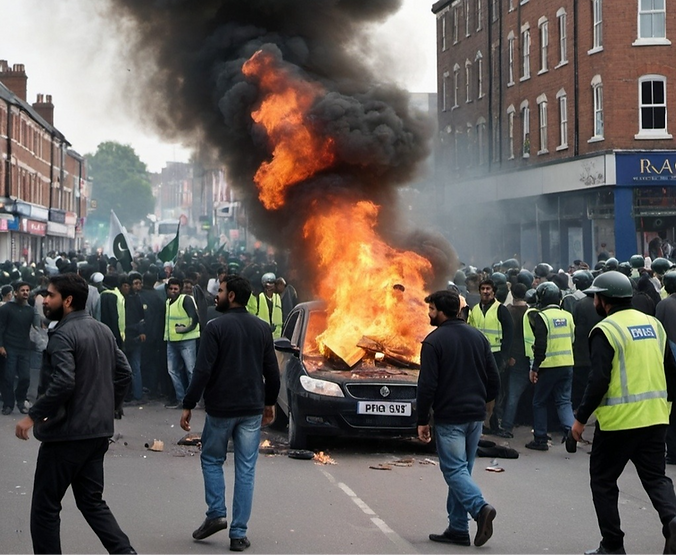
On the night of 18th July 2024, the streets of Harehills became a battleground. According to multiple reports, including the Daily Mail, what began as a minor altercation spiralled, involving social services, into an all-out riot. Riot police were deployed to restore order as the situation grew increasingly volatile, with reports of vandalism, arson, and attacks on law enforcement.
A police patrol car was torched, and officers were pelted with bricks and fireworks. The intensity of the violence was such that additional units had to be called in to support the local forces. It is unclear if the incident has led to any arrests and serves as a stark reminder of the tensions simmering beneath the surface in many of our cities. This incident is part of a disturbing trend of unrest in areas with high concentrations of Muslim residents, highlighting ongoing integration challenges.
Historical Context of Community Unrest
The disorder in Leeds is part of a troubling pattern of riots and public disturbances that have plagued the UK, often involving predominantly Muslim communities. These events are not new. We saw similar chaos in Birmingham in 2005, the 2011 London riots, and more recently, the violence in Leicester in 2022. Aggressive cultural norms and values is not common across all cultures that integrate into the UK, with these incidents of mass violence not normally being associated with Hindu, Sikh or Jewish communities, although they may be the targets of some of these cases (eg: Leicester, 2022). To successfully sweep these issues under the rug, the political and media establishment falsely diagnose any opposition to mass violence as "racially motivated". The pretence of this resistance being about race is not only a lie, but also extremely dangerous, and feeds the cover ups of serious crime and disorder that have become way too common in the UK.

The Myth of the "Far-Right Threat"
In the discourse on public safety, there is frequent mention of a "far-right threat." However, this threat is largely overstated in today’s society. Since the welcomed death of groups like the British National Party (BNP) and neo-Nazi organisations decades ago, the far-right has been significantly weakened to near extinction. Today's reality shows that the most pressing issues come from the failure to address the integration and assimilation of certain communities. Critics often attempt to draw parallels between these riots and the behaviour of football fans. However, such comparisons are not only unfair but also misleading. While football-related violence does occur, it is rare in modern Britain and almost always confined to match days, specific events and small numbers. In contrast, these muslim-majority riots are often more prolonged and stem from deeper societal issues.
Conclusion
The events in Leeds are a clear indication that the UK’s approach to multiculturalism needs a serious rethink. Rather than continuing to promote a failed ideal, it is time to address the root causes of these conflicts and work towards a more cohesive society. For our society of diverse beliefs and races to truly flourish, it is imperative that we unite under the grand banner of British values, fostering a sense of common identity and shared purpose that brings all communities together.


